- Thrive25
- Posts
- Issue #487: 3 Small Wins That Will Change Your 2026
Issue #487: 3 Small Wins That Will Change Your 2026

Ryan Schneider
January 06, 2026

Good morning. It’s Tuesday, January 6th.

In today’s email:
Focus: 3 Wins to Make 2026 Better
Learn: New Study on Saturated Fat
In the News: The Great Detachment
Brain Games: Calcudoku
Stat of the Day

The number of people who “quit” on their New Year’s resolutions by the second Friday in January.
Learn
3 Wins to Make 2026 Better
I’ve read more and more about people NOT going after New Year’s resolutions this year.
I get it - life isn’t meant to be one long checklist of self-improvement. We don’t always need to be chasing the next goal or fixing something about ourselves.
Sometimes, just being more present in the life we already have - how we move through our days, how we treat our bodies, how we show up for people we care about - that’s enough.
Still, the moment most people actually stop and think about their health is when the calendar turns. This year, 6 of the top 7 resolutions in the U.S. are health-related.

So whether you’re setting intentions…or completely over resolutions:
You don’t need a big plan for 2026.
You don’t need to overhaul your life.
There are three simple actions that would make almost anyone’s 2026 meaningfully better. Not abstractly. Not someday. But in how you feel every week.
These aren’t “longevity” actions where you need to wait 25 years for the benefit - they’ll make life better right now.
1. Go All Out (On Purpose)
The top biomarker for your longevity - VO₂ max.
VO₂ max is our body’s ability to use oxygen during hard effort. And it turns out to be one of the strongest predictors of how long - and how well - we’ll live. High vs. low VO₂ max is a bigger impact on all-cause mortality than whether or not you smoke, have diabetes, or even high blood pressure.
Why? Because it reflects how well your heart, lungs, blood vessels, and muscles work together under stress. It’s real-world fitness.
You just need to get breathless.
That means short bouts where you’re working out at about 80-90% of what you can do.
Run, bike, swim, climb stairs, brisk walk uphill, even fast bodyweight work. Push for 1-3 minutes, recover, then do it again.
Start with 1 session a week if this is new. Build toward 2-4 over time. Protect your joints, respect your body - but don’t avoid intensity.* It’s your prescription for youth and energy.
Table to measure your VO₂ max:

2. Don’t Eat After Dinner
Instead of obsessing over what to eat this year, try changing when you eat.
A simple rule that works for almost everyone: don’t eat after dinner.
You’ll naturally reduce late-night snacking, lower total calories, improve blood sugar control, and - this is big - sleep better. You give your body a break from digestion so it can actually recover overnight.
Most of what we eat late at night isn’t helping us anyway.
This one change quietly creates a daily fasting window without tracking, apps, or rules. And if you add a short walk after dinner? Even better. That movement helps glucose management and reinforces the habit loop.
It’s simple. It’s boring. And it works.
3. Call Your Friends
Yes - this is a health habit.
A recent study of over 30,000 adults found that social isolation causes faster cognitive decline later in life. Not correlates with - causes. Higher risk of dementia. Higher risk of Alzheimer’s.
Beyond the data, there’s a simpler truth: life is better when you’re connected.
We’re always busy. We’ll always have a reason to push lunch or coffee plans to “next week.” But the years move fast. 2050 is closer than Y2K.
Protect your relationships like you protect work meetings. Don’t let a week go by without spending time with someone you enjoy. Call them. Walk with them. Eat with them. Laugh a little.
This isn’t extra. This is the whole point.
* Always consult your trusted medical professional before starting any new fitness or exercise routine.
Thrive25 Partner Spotlight
As Thrive25 readers, you’ve heard curcumin (an active compound in turmeric) is good for you. But did you know that our body can’t absorb most of what we eat? Until now…
SuperNatural BodyControl is a fast-acting anti-inflammatory and detoxification supplement that utilizes a groundbreaking, patented process to enable BioSoluble® CurcuminTM to penetrate the GI and blood-brain barrier, which is up to 42X more water soluble than standard curcumin.
Kick off your 2026 health goals with BodyControl.
Measure
New Study on Saturated Fat
When it comes to macronutrients, most of the science points in the same direction: more protein, fewer simple carbs.
Fat, though, has always been messier.
For decades, “fat” became the villain - not because dietary fat makes us fat, but because the word sounded bad. The low-fat craze of 20-30 years ago pushed people to avoid fat at all costs.
And that’s where things went sideways.
When fat came out of food, sugar and refined carbs went in. Those “fat-free” swaps didn’t make us healthier - they made things worse:
Poor blood sugar control
Higher triglycerides
More insulin resistance
More inflammation
So the real question isn’t Should we eat fat?
It’s Which fats, for whom, and compared to what?
A brand-new December 2025 systematic review published in Annals of Internal Medicine analyzed 17 randomized trials involving more than 66,000 people. It’s key to point out here that randomized trials are far more reliable than the nutritional studies that simply ask people what they remember eating.
Here’s the key findings:
For people at low cardiovascular risk, reducing saturated fat over ~5 years led to little or no meaningful benefit for heart attacks, stroke, or overall mortality.
For people at high cardiovascular risk, reducing saturated fat did matter - especially when it was replaced with polyunsaturated fats, not carbohydrates.
The strongest signal showed up for non-fatal heart attacks, with risk reductions approaching 25% when saturated fat was replaced with polyunsaturated fat.
There is no one-size-fits-all nutrition advice - and saturated fat is a perfect example.
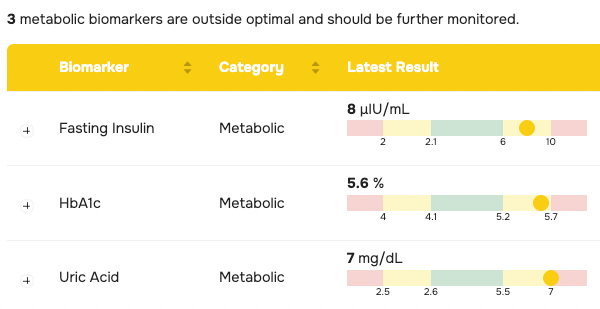
If someone already has elevated LDL cholesterol, ApoB, inflammation (C-Reactive Protein), or insulin resistance (HbA1c or fasting insulin), saturated fat can push cardiovascular risk higher.

If someone is metabolically healthy with favorable biomarkers, the data does not clearly show saturated fat is harmful - especially in the short to medium term.
That’s why diet advice without biomarkers is mostly guesswork.
Different foods affect us all differently - that’s why your numbers matter (not headlines).
Practical Takeaways
Prioritize unsaturated fats first
Olive oil, fatty fish, nuts, seeds, avocados. These consistently show benefits across risk profiles.Don’t replace fat with sugar
“Low-fat” often means refined carbs - never the right choice.Know your biomarkers before changing your diet
Get your metabolic and heart markers every year.
Nutrition is personalized - adjust to what you need, not what you read.
👉 Ready to get your biomarkers? Get started with Thrive25 Personal Health OS.
H&L in the News
Recovery, But Super Expensive: From cryochambers to altitude rooms and six-figure energy pods, the ultra-wealthy are turning recovery into a sci-fi experiment. Inside the high-tech training tools redefining elite fitness - and their eye-watering costs. (Outside)
The Age of Emotional Distance: In this sweeping reflection, David Brooks argues we’re living through a “Great Detachment” - as autonomy replaces attachment, love, faith, marriage, and community erode. The result: less meaning, more loneliness, and a culture starved for connection. (NYTimes)
The Power of In-Between: Stuck between what was and what’s next? Neuroscience shows liminal spaces boost learning, creativity, and resilience - if you flip anxiety into curiosity. Here’s how to turn uncertainty into growth. (Big Think)
Brain Games
Calcudoku
The objective is to fill in the grid with the correct digit in each cell, between 1 and 5:
Each row contains exactly one of each digit
Each column contains exactly one of each digit
Each bold-outlined group (with same color) must equate the result with the numerical operation - addition (+), subtraction (-), multiplication (x) and division (/)

It’s go time - this one is a little bit easier than others we’ve shared - try to solve this in under two minutes. Ready…set…go!
Credit: Brainzilla
** For answer, scroll to the bottom of the email
Thrive25 Referral Program
Thanks for being part of the Thrive25 community! Want to further support our mission of transforming science into digestible insights to support our health & longevity. Earn Thrive25 swag and other rewards from our Sponsors via our referral program:

Thanks for joining us today!
Want to see what we’re up to? Sign up for early access to our platform
Missed an issue? No problem, check out our newsletter archive
Got feedback, recommendations or stories to share? Tell us what’s on your mind here
Someone send you this email? Sign up here
Brain Games Answer


We’re 40-something dads that felt our bodies and minds start to slow down and we’re not ready for that. We found too much information on every subject. So we started Thrive25 to transform what we’ve learned into something useful for the rest of us to spend just 5 min a day to optimize our health & longevity.
This newsletter is for you and we truly value your feedback. Never hesitate to reach out to us at [email protected].
To health!